Listening to the Land: Ranjit Barthakur’s Vision for Community-Led Conservation in the Northeast
Nestled in the Himalayas and fed by the Brahmaputra, India’s Northeast holds some of the world’s richest biodiversity, yet it remains one of the country’s least understood regions. For decades, it has stood at the periphery of the national imagination: resource rich but underinvested; present in policy discussions but rarely heard in its own voice.
It is in this landscape shaped by forests, rivers, and long histories of stewardship that Ranjit Barthakur’s giving journey took root two decades ago. Ranjit's philanthropy has always been driven by what it means to give in a region where environment and livelihood are profoundly interlinked. “Philanthropy should not be reduced to writing cheques,” he says. “The purpose of life and business itself is social giving.” Through the Balipara Foundation, this philosophy has evolved into the Naturenomics™ framework that challenges the binary between conservation and development by treating forests, local economies, and governance as parts of a single system. Across the Northeast, this approach has grown into a quiet but determined movement. “We must stop treating nature as an obstacle to development,” Ranjit says. It is, in fact, the powerhouse that sustains it.”
An Identity Rooted in Place
Ranjit’s childhood in Assam offered a vantage point few philanthropists begin with, shaped by the rhythm of tea estates, the breath of swollen rivers, and the intuitive understanding that human prosperity is inseparable from the health of the land. Growing up in the rolling gardens of Jorhat, he saw early the quiet interdependence between soil and schooling, between a community’s welfare and the ecosystems around it. These early experiences, absorbed more through observation than instruction, formed the foundations of what he would later call social profit. “The real question, is not whether a business can make profit, but whether it is designed to create economic as well as social profit.”
In the Northeast, nature is also a constant companion. “It’s selfish,” he jokes, “I just love the green.” But beneath the humor is a deeper attachment to the forests and floodplains he grew up with, that have shaped his belief that giving is a form of restitution, a way to repair relationships that development models have strained.
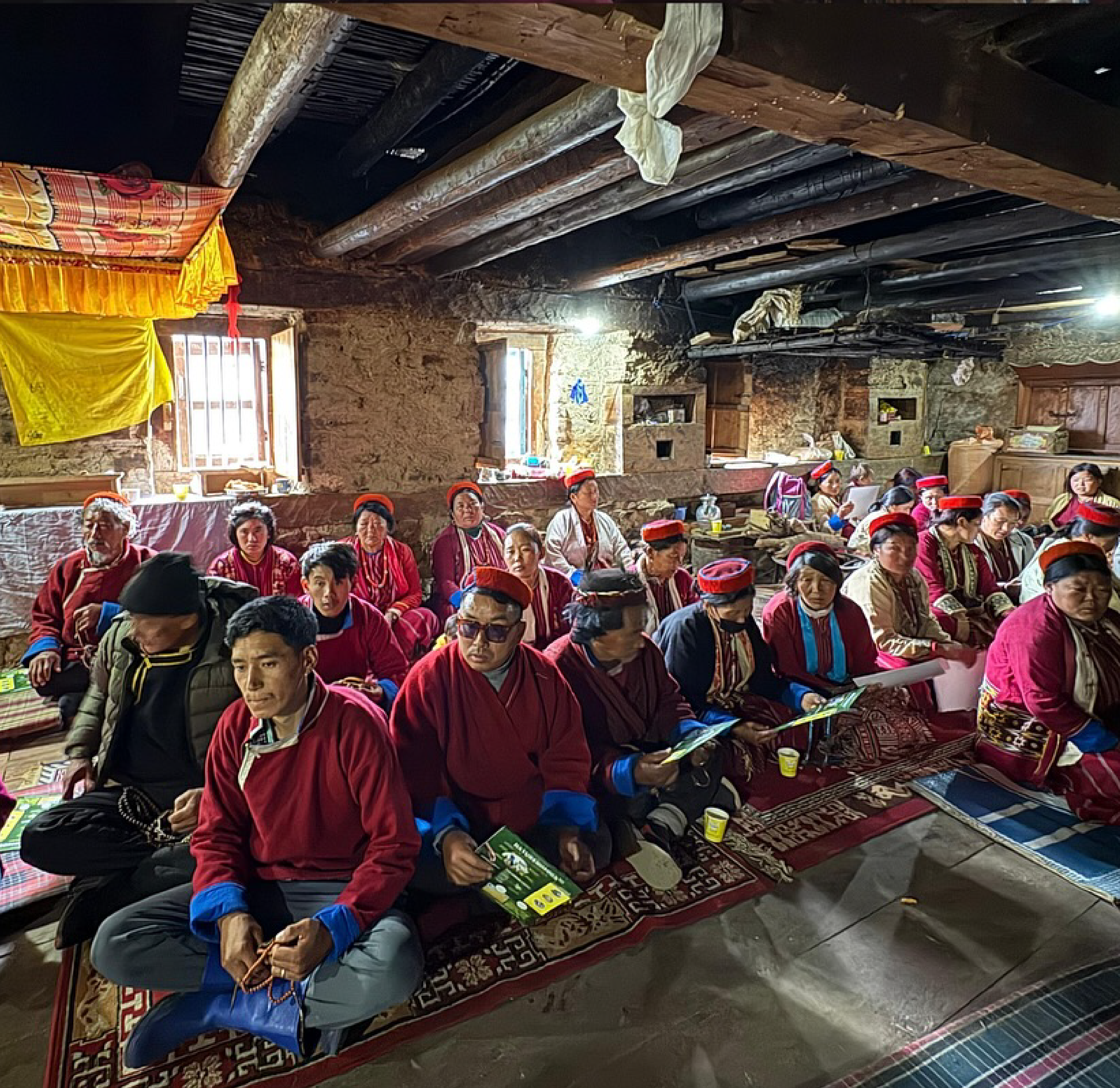
100,000 saplings planted in Udalguri, Assam, under the Udalguri Landscape Mission, made possible with the support of Axis Bank Foundation
“We must build on our natural-assets or forest-assets so as to provide a stable source of income and basic amenities for the fringe communities. The circulation of our resources from the environment has to be circular in nature and the economy must adhere to this concept.”
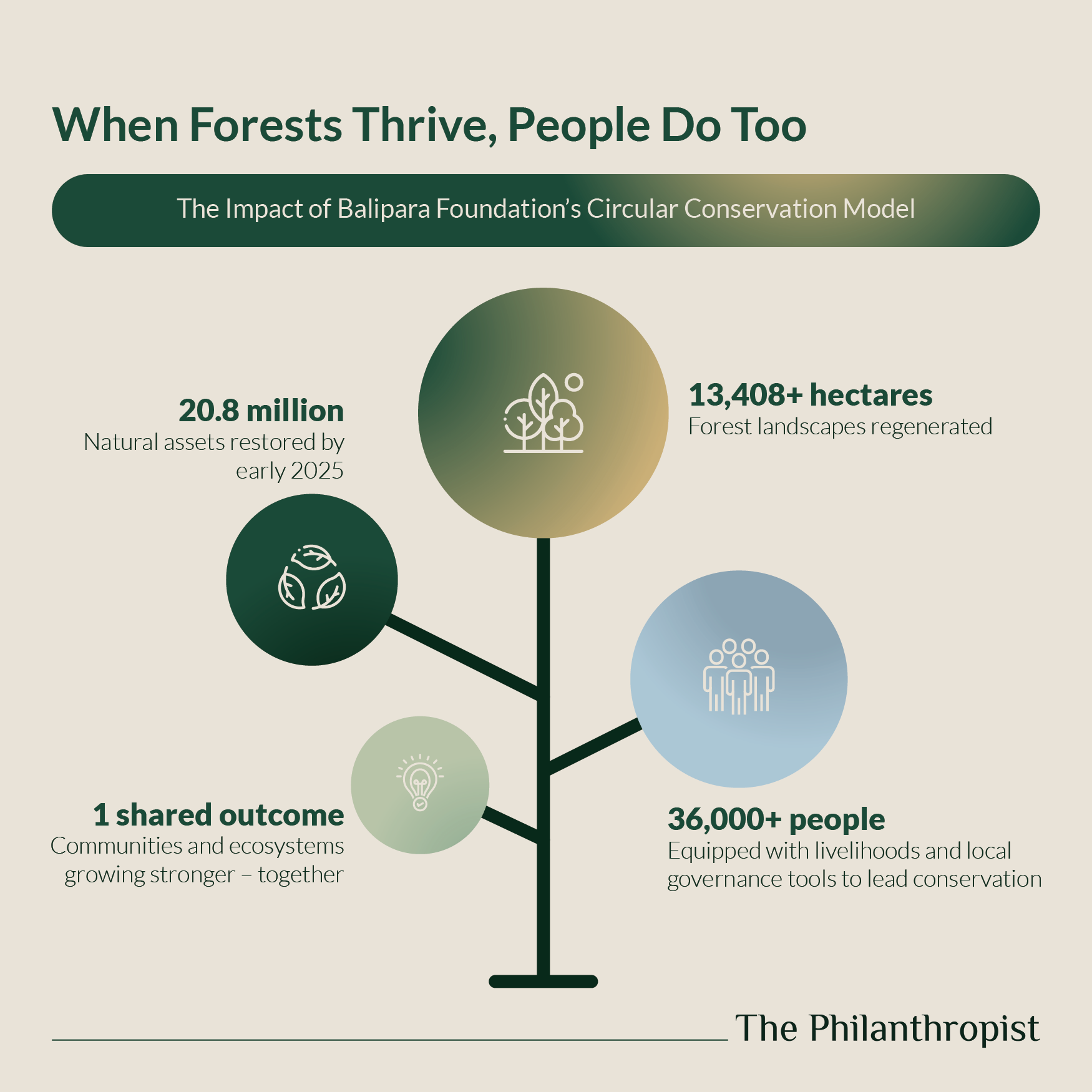
Balipara Foundation’s circular conservation model shows how thriving forests and empowered communities grow together
The Early Chapters: From Health to Systems Change
Ranjit’s philanthropic journey did not begin in forests but in operating theatres. In 2002, he founded Mission Smile, to deliver free cleft surgeries to children across the Northeast. At the time, access to such procedures was limited; specialized care was concentrated in metropolitan hospitals, and the cost placed treatment far beyond the reach of most families in the region.
The model he helped build was ambitious for its time: a world-class cleft center in Guwahati; partnerships linking local hospitals to international medical expertise; and collaboration with state governments to expand access throughout the region. More than 25,000 surgeries later, what stayed with him was the insight the work revealed: “We started by fixing clefts,” he says, “but ended up realizing we needed to heal entire systems.” The limitations were not medical alone. A child’s ability to reach a surgical center depended as much on weather, roads, transport, parental income, and local governance as on the presence of trained doctors. Health, he understood, could not be separated from ecology, infrastructure, inequality, or public administration.
This realization would become the lens he later applied to conservation, sustainable livelihoods, and community governance: that problems in the Northeast rarely exist in isolation, and neither can solutions.
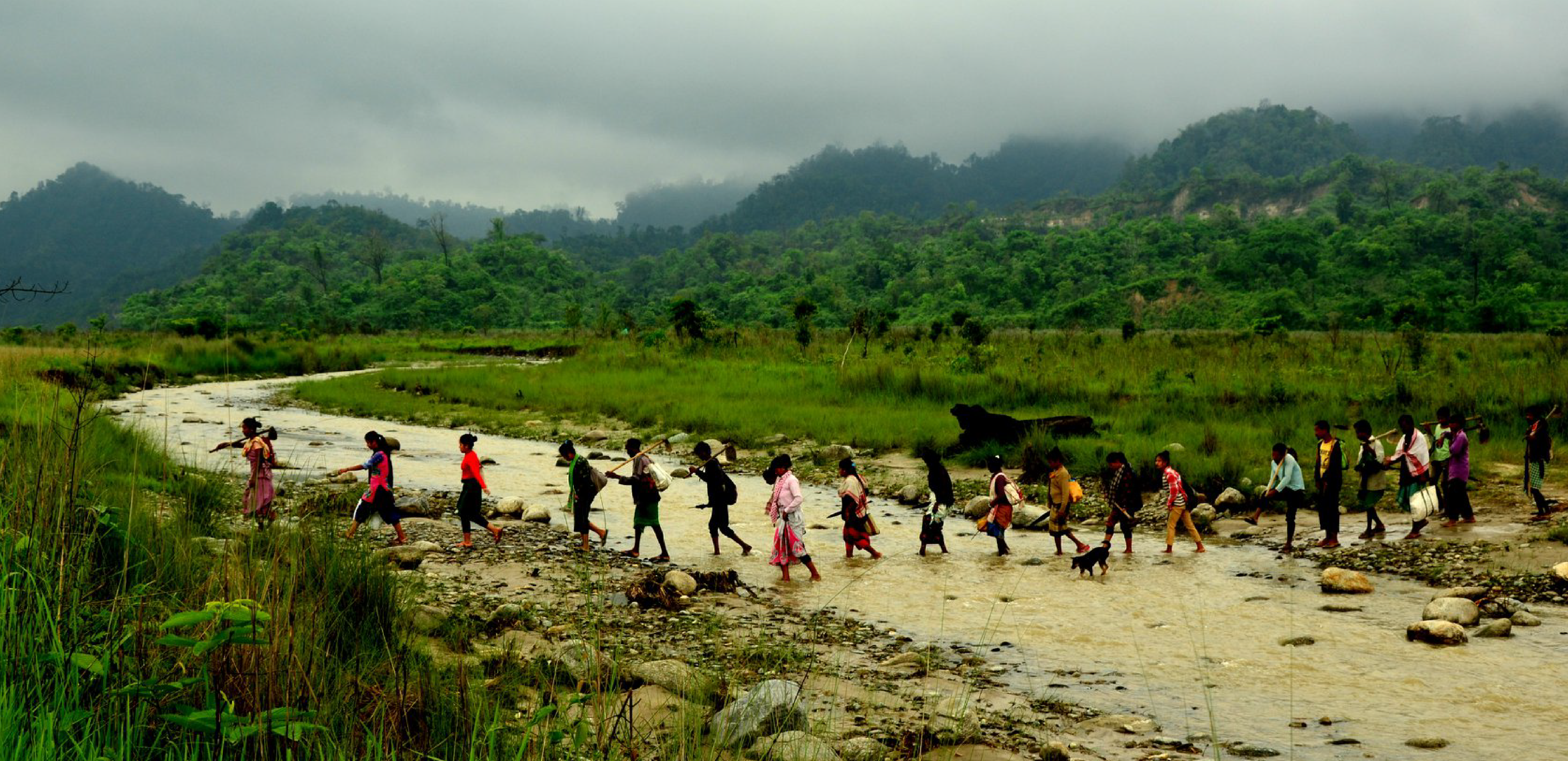
100,000 saplings planted—a key milestone for the Udalguri Landscape Mission in Assam, achieved with the support of Axis Bank Foundation and the collective efforts of the Dhunsiri JFMC and the ULM project team

Measuring What Matters
For Ranjit, one of the central challenges is the mismatch between what ecosystems need and what traditional metrics are designed to capture. “Our financial systems value what we can count, not what truly counts,” he says. Philanthropy, he argues, must move beyond output-driven reporting and toward integrated accounting — where ecological indicators such as soil health, water tables, biodiversity recovery, and cultural vitality sit alongside conventional financial measures.
“What if every balance sheet included trees saved or ecosystems restored? What if every rupee earned was assessed for its ecological footprint?” This is not just philosophical; it shapes how the Balipara Foundation operates. With a lean core team and about eight percent of spending dedicated to administration, the organization functions as a distributed ecosystem rather than a single headquarters-led entity. Researchers, community leaders, field teams, and partner institutions collaborate across landscapes reinforcing his belief that systems change cannot be centrally orchestrated, only collectively stewarded.
Raising capital for this kind of work, however, remains one of philanthropy’s blind spots. Many philanthropists are more comfortable in funding visible, time-bound interventions than the slower, non-linear work of ecological regeneration. Issues like salamander habitats in Nagaland or wetland restoration in Manipur can appear niche or intangible to funders accustomed to metrics tied to cost-per-beneficiary or measurable “lives impacted”. “Regeneration doesn’t follow linear metrics,” Ranjit says. “You can’t quantify a forest’s soul.”
Climate volatility has made these gaps more urgent. In recent years, unprecedented flooding in the Eastern Himalayas has undone months, sometimes years of restoration work. For Ranjit, these events are reminders that philanthropy in fragile ecologies demands humility, patience, and models capable of absorbing shock. As he puts it, “You can replant a forest, but you also have to rebuild people’s relationship with nature and with hope.”
As conservation efforts begin to generate income, whether through agroforestry, payments for ecosystem services, or nature-based enterprises, communities are initiating new conversations about fairness and governance. They are asking how benefits from restored forests should be shared, who gets to decide how income is reinvested, and how local enterprises can expand without tipping into extractive practices. These questions signal a shift from conservation as subsistence to conservation as self-determination. Communities are no longer passive participants in development models; they are increasingly asserting their right to shape them.
This transition also places new demands on philanthropy. It requires funders to consider how to support rising aspirations without encouraging a replication of urban materialism, and how to define “a better life” in ways that move beyond higher consumption or visible assets. For Ranjit, the answer lies in reframing aspiration itself. “A good life,” he says, “is one where people have dignity, connection, and purpose.” In the Northeast, where ecology, culture, and identity are deeply intertwined, this becomes a practical guide for what philanthropy should measure, prioritize, and ultimately value.
Lessons from a Life of Giving
After decades of work across industries and causes, Ranjit distills a set of principles he believes new philanthropists must internalize early. At their core is a simple truth: systems do not shift through prescriptions, but through participation. “You cannot prescribe change. You can only co-create it.”
For him, this means entering a field with respect for what already exists — the people, institutions, and knowledge systems that have shaped a landscape long before philanthropy arrives. Rather than seeking to build from scratch, he urges funders to strengthen what is working, fill structural gaps, and collaborate without competing for visibility. In a region as complex as the Eastern Himalayas, the most durable solutions come from aligning with local leadership, not superseding it.
Ranjit is clear that meaningful giving demands discomfort: the willingness to unlearn, to sit with ambiguity, and to recognize that the “right answer” may not reveal itself quickly. “If your giving feels easy,” he says, “you’re not changing the system.” For him, the role of philanthropy is less about directing resources and more about reshaping one’s own assumptions: about value, aspiration, equity, and growth.
A Regenerative Vision for India
Looking ahead, the invitation before India’s philanthropy ecosystem is clear: to broaden our understanding of prosperity itself. True wealth, Ranjit reminds us, lies in the resilience of the forests, rivers, and communities that sustain us. As India charts its next chapter, it must redefine its notion of capital to include ecological systems, and to embed that recognition into how we design policy, measure progress, and govern our shared future.
For the sector, this means adopting a regenerative vision, that asks corporations, funders, and civil society to reimagine value chains, invest in nature-positive models, and rebuild our economies on principles of reciprocity rather than extraction. Balipara Foundation’s own journey is but one illustration of what this could look like: a living laboratory where conservation, livelihoods, and culture reinforce one another. But the call is bigger than any single institution.
“The world needs more givers who understand that their own well-being depends on the well-being of everything around them.” The question now is whether India’s philanthropy ecosystem will meet this moment, by funding boldly, collaborating deeply, and choosing regeneration as the foundation of our collective prosperity.


YOU MAY ALSO LIKE
Read more

_1028133513.png)
Read more