Queering the Blueprint: Keshav Suri on Reimagining the Foundations for an Inclusive India
In February 2025, when Keshav Suri stepped onto the stage beside his co-founders to launch Pride Fund - India’s first philanthropic fund dedicated entirely to LGBTQIA+ communities - he paused for a heartbeat. Before him, the auditorium at Godrej One shimmered with familiar faces: civil-society stalwarts, young activists with fire in their eyes, seasoned allies who had weathered decades of silence, queer and trans people of every age and possibility, and leaders from business and the arts who had quietly pushed open doors where once there were only walls.
For a moment, the hall seemed to glow. And in that glow, Keshav saw the arc of a journey that had taken decades to gather strength.
Part of that arc stretched back to 13 October 2018, when he had stood before civil-society voices and corporate leaders in Delhi, only weeks after the Supreme Court struck down the law criminalizing same-sex relations. It was a historic judgement, but also a beginning of the long journey to mainstream inclusion for queer communities. Real safety, opportunity, and belonging would demand sustained effort, partnership, and a fundamental reworking of the conditions that shape LGBTQIA+ lives.
Keshav Suri Foundation emerged from that understanding. From the start, the Foundation chose to focus on the systems beneath the surface - livelihoods, mental health, education, safety, and workplace inclusion - recognizing that progress for LGBTQIA+ communities needed to be structural and systemic. Today, it has become a national platform that unites collaborators and companions from all walks of life, in building a hard-won, wholly possible future that is wide enough to hold everyone in its embrace.
An Early Education in Equality
For years, Keshav has walked the tightrope between personal identity and public responsibility. He leads the family business, as Executive Director of The Lalit Suri Hospitality Group and also helms the family’s philanthropic foundation. He likes to joke about juggling “the day job and the gay job,” but beneath the humor lies a steadfast conviction: a belief that privilege ought to be used to widen possibility for others.
He attributes this worldview to the environment he grew up in. His parents modelled partnership at home and in the family business, and decisions were shared in ways that made hierarchy less visible. These everyday experiences, he says, shaped his understanding of fairness long before he developed the vocabulary to describe it. They taught him that dignity is expressed not only through rights but through how people are heard, included, and recognized in daily life.
His aunt, Mrs. Ritu Suri, provided another influence. When she founded Step by Step, a school in Noida, she chose not to name it after herself or her family. Instead, she built an institution that would be run democratically, led by educators, growing in mind rather than molded in image. Keshav often returns to this principle – that institutions must ultimately outgrow their founders. Although KSF bears his name, he sees its purpose as ever-evolving, in response to the changing times and unchanging struggles of the LGBTQIA+ communities in India.
The Lalit team participating in a Pride march, underscoring the role of institutions in advancing inclusion
“DEI is already stitched into India’s DNA, whether in the clauses of the Constitution, or in the rhythms of its festivals and markets, as in the unspoken rules of villages and cities alike. From caste to race, from religion to sexuality, diversity is an indispensable part of the India story, sometimes celebrated, often contested, always present.”
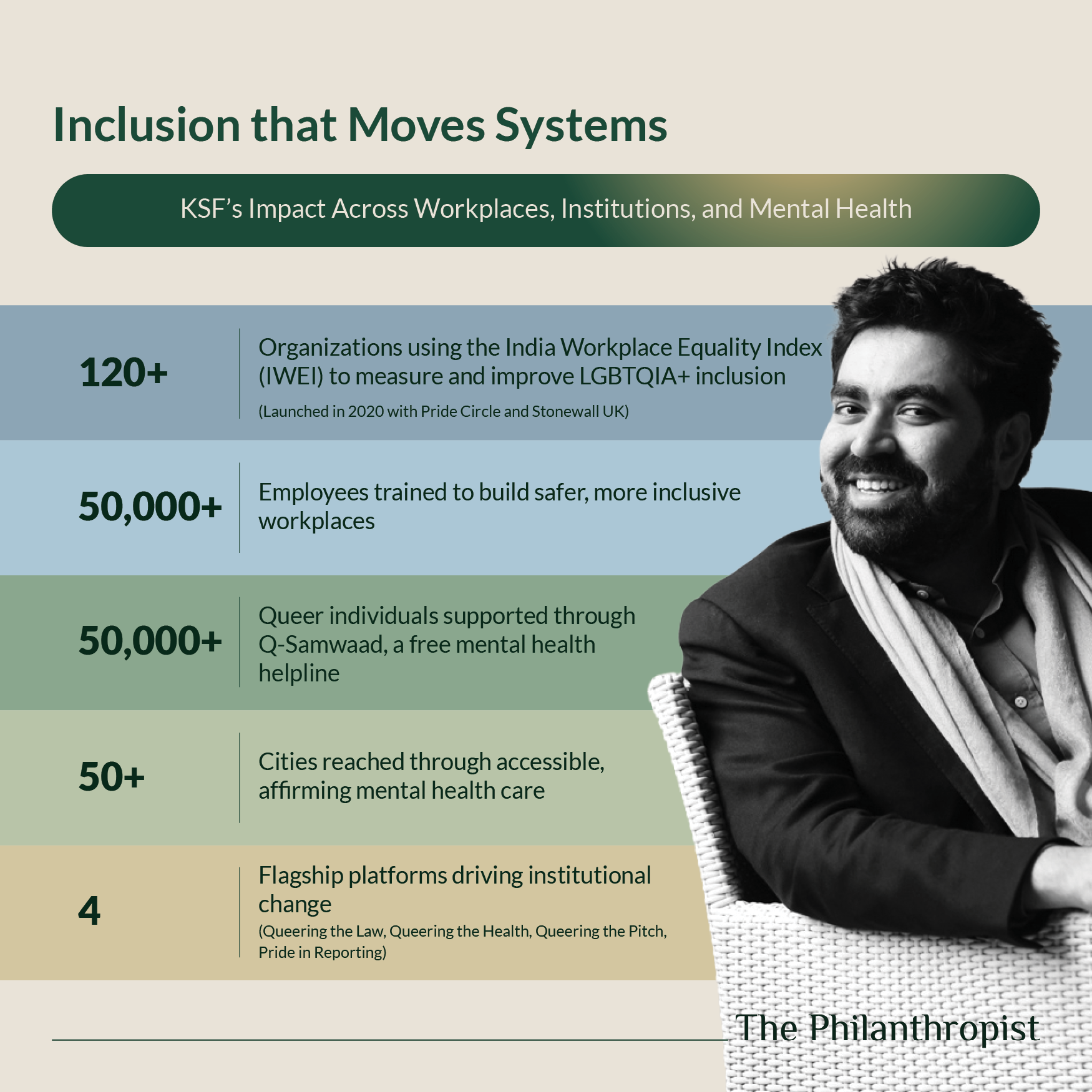
KSF’s multi-pronged approach shows how inclusion can move systems - reaching institutions, employees, and communities across India
Queering Mainstream Philanthropy
When Keshav began engaging in legal petitions and public campaigns for LGBTQIA+ rights, he quickly saw how limited India’s philanthropic infrastructure was for queer communities. This became even more evident in 2018, when he explored bringing the It Gets Better campaign to India. The initiative—one of the world’s largest storytelling efforts for LGBTQIA+ youth—had been partnering with organizations across vulnerable geographies, yet in India, the landscape was strikingly desolate. Few registered groups had the mandate or capacity to take on the work.
KSF stepped in as an implementing partner, but the experience revealed something deeper: the need for institutions that could hold this work in a sustained, systemic way. It underscored a larger gap—one that could not be addressed by programs alone, but by building long-term structures for inclusion, safety, and dignity.
For KSF, the questions became calls to action: How does a queer or trans person find a job? Who ensures that the workplace they enter is safe? What enables someone to participate fully in society?
For LGBTQIA+ individuals, the barriers often lie across multiple systems - workplaces, educational pathways, healthcare access, and public attitudes. KSF’s approach, therefore, has been to work across these points of exclusion and build models that can be adopted and scaled by others. “Rights mean little,” he says, “if you do not have the dignity to exercise them.”
Their early work centered on livelihood programs, that build pathways to economic independence for LGBTQIA+ individuals, people with disabilities, and acid attack survivors. Through initiatives like Q-Rious, RISE, and Vividhataa job fairs, the foundation has successfully linked marginalized talent with inclusive employers, while Pride Kraft and Project Prahari offer hands-on training in hospitality and entrepreneurship. Most recently, TRANSaction, a workshop for aspiring talent in the entertainment industry was also launched, recognizing the lack of visibility for queer and trans representation itself across media. 11 editions of this endeavor have been conducted across five cities so far. According to Keshav, the queer community is the “microcosm of the macro picture” for all marginalized groups, and therefore inclusion for queer professionals — by designing blueprints of belonging for every identity that development once overlooked — forms the core of the foundation.
He saw education as another anchor. Through initiatives like KSF Connect and the Queer Youth Leadership Course, the foundation works with universities and young changemakers to build empathy, leadership, and confidence among queer youth. The Aditya Nanda Scholarship, established in 2019 and renamed in 2020 in memory of Keshav’s cousin, reflects this commitment. “Aditya was the person who encouraged Keshav to live authentically and connected him to a wider community of acceptance. Renaming the scholarship in his honor was, for Keshav, the most meaningful way to carry forward that legacy, to create pathways for others to live the truth Aditya inspired in him," recalls Divya Suri Singh (Keshav’s sister and Executive Director, The Lalit Suri Hospitality Group). His loss underscored the need for supportive environments for young queer people. Each year, the scholarship supports LGBTQIA+ students to pursue a diploma in Food Production and Bakery at The Lalit Suri Hospitality School, with recent expansions to Lovely Professional University and the Indian School of Hospitality. By investing in queer professionals’ education and career advancement, KSF envisions a future where representation extends across hierarchies.
Over time, KSF has launched inclusive job fairs and scholarships, trained queer-affirmative counsellors, and built mental health helplines. Launched in 2020, the India Workplace Equality Index (IWEI) in collaboration with Pride Circle and Stonewall UK, has given 120+ organizations the tools to measure and improve LGBTQIA+ inclusion, and trained over 50,000 employees. Through its flagship series, Queering the Law, Queering the Health, Queering the Pitch, and Pride in Reporting, KSF is facilitating urgent, pivotal conversations toward structural change in how courts, hospitals, workplaces, and even media understand the queer experience.
For instance, KSF’s mental health initiatives begin at the root, with building platforms for listening, with empathy and intentionality. Q-Samwaad, a free helpline has supported over 50,000+ queer individuals across more than 50 cities through accessible, affirming care. In partnership with the Mariwala Health Initiative, trainings for a new generation of queer-affirmative counsellors have also been conducted. The act of being heard, believed, and affirmed is as powerful as any reform.
KSF has also marked several historic firsts in India’s journey toward inclusive sports, by organizing cricket, football and badminton tournaments, hosting eight events across Delhi, Bengaluru, and Jaipur to create wider access for marginalized athletes.
Through its partnership with Special Olympics Bharat, the foundation plays a key role in advocacy and skilling, supporting the mainstreaming of persons with disabilities and helping athletes connect with employment opportunities. Together, these initiatives reflect KSF’s commitment to reshaping India’s sporting landscape through dignity, visibility, and inclusion.
However, among KSF’s most significant contributions towards mainstreaming queer philanthropy in India, is co-funding the Pride Fund, alongside Radhika Piramal and Godrej Industries. In its inaugural year, it mobilized grants worth INR 2 Crores for 8 grassroot NGOs in India. “True inclusion must be redistributive,” Keshav reminds us. The Pride Fund embodies this conviction and represents a new chapter in India’s journey towards ensuring support for queer-led organizations working with India’s queer communities.

The TRANSaction Acting Workshop brings queer artists together in a shared space of expression, offering professional training and industry access under the mentorship of Faraz Arif Ansari, with support from KSF
A Different Lens to View Output
Keshav has long cautioned against equating impact with volume. “We’ve mistaken the algorithmic promise of x rupees = y outcomes for impact,” he says. For LGBTQIA+ communities, meaningful progress depends on shifting systems, cultures, and expectations — changes that are not easily captured through short-term metrics. Where KSF does use numbers, they reflect depth rather than scale: placements made through job fairs, the reach of mental health services, and the emerging leadership of queer professionals.Over the years, the foundation’s work has impacted more than one million lives through a range of programs designed not for optics but for endurance. Their education initiatives have sensitized over 8,000 students and 500 faculty, while skilling efforts have trained nearly 4,000 LGBTQIA+ and PwD individuals for stronger economic participation. Working with more than 200 corporate partners across India, KSF has helped embed inclusion into the everyday rhythms of workplaces.
Keshav also points out that diversity is not new to India; it is embedded in its constitutional framework and social landscape. The dream is not to impose inclusion from the outside, but to draw it out from within.
But dreams, Keshav insists, are not enough if they do not sit in seats of power. India 2047 must be a nation where queerness is as visible in pride marches, as also in the corridors of governance: legislatures, panchayats, law enforcement, educational bodies, and the judiciary. He believes that "the future of India is queer, in every sense of the word, and the future of the world is India.”
Only when LGBTQIA+ voices sit at the tables where decisions are made, budgets allocated, justice dispensed, and security enforced by those who themselves have been othered, will inclusion stop being a promise. This perspective underpins KSF’s approach: building the structural conditions that allow queer individuals not only to access systems, but to contribute to shaping them. Progress is uneven and incremental, but it is through these steady shifts that inclusion moves from principle to practice, bringing us closer to an India in whose ideals everyone can finally see themselves reflected.


YOU MAY ALSO LIKE
_508391263.png)
Read more

Read more
_374152232.png)